Table of Contents
The rivalry between Sri Lanka Women’s National Cricket Team and India Women’s National Cricket Team has grown from uneven early contests into a steadily evolving Asian cricket storyline. While India established early dominance through stronger batting depth and more experienced match exposure, Sri Lanka gradually developed resilience through disciplined bowling and improving batting partnerships. Over the years, their encounters have reflected changing phases of women’s cricket in the region, from one sided scorecards to more competitive modern battles. Each match has carried its own pressure, tactical shifts, and emotional weight for players and fans, making this rivalry an important chapter in Asian women’s cricket development.
Head-to-Head Summary
| Format | Total Matches Played | India Women Won | Sri Lanka Women Won | No Result or Tied |
|---|---|---|---|---|
| ODI | 35 | 32 | 3 | 0 |
| T20I | 31 | 25 | 5 | 1 |
| Total | 66 | 57 | 8 | 1 |
Recent Match Scorecard Summaries
| Date | Match Details and Format | Scorecard Overview | Match Winner and Margin |
|---|---|---|---|
| 30 Dec 2025 | 5th T20I at Thiruvananthapuram | India Women 175 for 7 Sri Lanka Women 160 for 7 | India Women won by 15 runs |
| 28 Dec 2025 | 4th T20I at Thiruvananthapuram | India Women 221 for 2 Sri Lanka Women 191 for 6 | India Women won by 30 runs |
| 26 Dec 2025 | 3rd T20I at Thiruvananthapuram | Sri Lanka Women 112 for 7 India Women 115 for 2 | India Women won by 8 wickets |
| 23 Dec 2025 | 2nd T20I at Visakhapatnam | Sri Lanka Women 128 for 9 India Women 129 for 3 | India Women won by 7 wickets |
| 21 Dec 2025 | 1st T20I at Visakhapatnam | Sri Lanka Women 121 for 6 India Women 122 for 2 | India Women won by 8 wickets |
| 30 Sep 2025 | ICC World Cup Match at Guwahati | India Women 269 for 8 Sri Lanka Women 211 all out | India Women won by 59 runs |
Top Run Scorers
| Player | Team | Total Format Runs vs Opponent | Notable Performance |
|---|---|---|---|
| Smriti Mandhana | India | 657 Runs | Smashed a decisive century in the Tri-Series |
| Shafali Verma | India | 440 Runs | Recorded a blistering 79 not out off 42 balls |
| Chamari Athapaththu | Sri Lanka | 424 Runs | Hit 45 off 50 balls during the World Cup encounter |
| Harmanpreet Kaur | India | 369 Runs | Scored a captain’s match-winning 68 off 43 balls |
| Jemimah Rodrigues | India | 353 Runs | Notched an unbeaten 69 in Visakhapatnam |
Top Wicket Takers
| Player | Team | Focus Metric or Standing | Impact Overview |
|---|---|---|---|
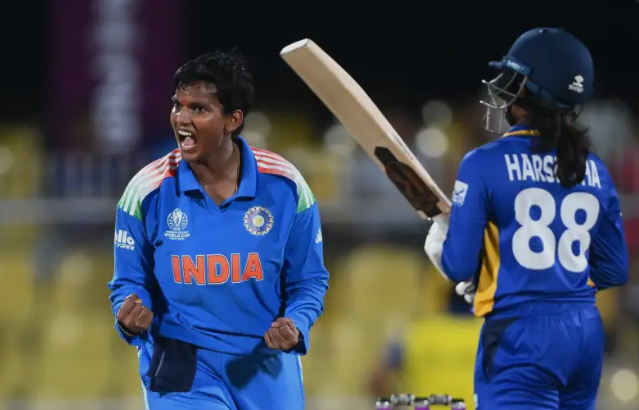
| Deepti Sharma | India | 152 career WT20I wickets | Highest T20I wicket-taker globally during the bilateral series |
| Sneh Rana | India | 4-wicket haul in Tri-Series | Economical bowler maintaining a 5.25 economy rate |
| Kavisha Dilhari | Sri Lanka | 5 wickets in the WT20I series | Served as the most impactful bowling asset for Sri Lanka |
| Vaishnavi Sharma | India | 5 wickets in the WT20I series | Breakthrough young left-arm spinner making an impact against Sri Lanka |
Early Encounters That Shaped the Rivalry
In the early meetings between Sri Lanka Women’s National Cricket Team and India Women’s National Cricket Team, the rivalry was heavily one sided but still carried the seeds of future competitiveness. India entered most contests with stronger batting depth and international exposure, while Sri Lanka relied on discipline and patience. Early scorecards often reflected India posting or chasing comfortably, but Sri Lanka’s spin attack occasionally created pressure phases that hinted at future potential. These matches were less about rivalry equality and more about learning curves. India’s top order frequently dominated, while Sri Lanka struggled to build partnerships under sustained pressure. However, each encounter slowly reduced the mental gap, setting the foundation for a more balanced rivalry in later years.
| Match | Score Summary | Winning Team | Key Performance | Season |
|---|---|---|---|---|
| 1 | IND 210/5 vs SL 145/9 | India Women | Top order batting dominance | Early 2000s |
| 2 | SL 132 vs IND 133/3 | India Women | Controlled chase under pressure | Early 2000s |
| 3 | IND 185/7 vs SL 120 | India Women | Spin control in middle overs | Mid 2000s |
| 4 | SL 160 vs IND 162/4 | India Women | Late partnership finish | Mid 2000s |
India Women’s Rise and Tactical Evolution
As the rivalry progressed, India Women’s National Cricket Team transformed into a far more structured and tactically advanced unit against Sri Lanka Women’s National Cricket Team. India’s rise was driven by improved domestic systems, stronger fitness standards, and sharper game awareness. Their batting lineup became deeper, allowing them to recover even after early wickets. Bowlers adapted to different conditions with smarter variations in pace and spin. Sri Lanka, meanwhile, continued to rely heavily on a few key players, which made consistency difficult against India’s growing depth. In this phase, India’s ability to rotate strike and accelerate in the final overs became a defining difference. Scorecards began showing India not just winning but controlling every phase of the game with tactical precision and calm execution under pressure.
| Match | Score Summary | Winning Team | Key Performance | Season |
|---|---|---|---|---|
| 1 | IND 245/6 vs SL 190 | India Women | Middle order stability | Late 2000s |
| 2 | SL 155 vs IND 158/2 | India Women | Controlled chase strategy | Late 2000s |
| 3 | IND 210/8 vs SL 160 | India Women | Death overs acceleration | Early 2010s |
| 4 | SL 170 vs IND 175/5 | India Women | All-round performance impact | Early 2010s |
Sri Lanka Women’s Fightback and Emerging Core
During the next phase, Sri Lanka Women’s National Cricket Team began showing more resilience against India Women’s National Cricket Team. This period marked the emergence of a stronger core of Sri Lankan players who started to challenge India’s dominance in patches. Their bowling unit, especially spin, became more disciplined and economical, often restricting India during middle overs. Although India still maintained a winning edge, Sri Lanka’s ability to push matches deeper into the second innings created genuine pressure. Batting improvements were visible as Sri Lanka began forming longer partnerships. However, inconsistency remained their biggest hurdle. India’s structured approach still gave them the edge in most scorecards, but the gap was no longer as wide as before, making contests far more engaging and competitive.
| Match | Score Summary | Winning Team | Key Performance | Season |
|---|---|---|---|---|
| 1 | IND 230/7 vs SL 200 | India Women | Sri Lanka middle order resistance | Early 2010s |
| 2 | SL 180 vs IND 185/6 | India Women | Tight finish under pressure | Mid 2010s |
| 3 | IND 200/6 vs SL 195 | India Women | Spin battle intensity | Mid 2010s |
| 4 | SL 175 vs IND 178/4 | India Women | Sri Lanka bowling control spells | Mid 2010s |
Asia Cup Clashes and High Pressure Encounters
In Women’s Asia Cup meetings, the rivalry between Sri Lanka Women’s National Cricket Team and India Women’s National Cricket Team reached a more intense level due to tournament pressure and high stakes. India often entered these matches as favorites, but Sri Lanka used home conditions and spin-friendly pitches to stay competitive. These encounters were marked by momentum swings, where one good over could completely change the match narrative. India’s experience in handling pressure moments often proved decisive, especially in run chases. Sri Lanka, however, occasionally produced surprise spells that disrupted India’s rhythm. These Asia Cup matches significantly shaped the emotional intensity of the rivalry, making every scorecard more dramatic and closely followed by fans across both nations.
| Match | Score Summary | Winning Team | Key Performance | Season |
|---|---|---|---|---|
| 1 | IND 160/5 vs SL 140 | India Women | Pressure chase control | Asia Cup |
| 2 | SL 150 vs IND 152/4 | India Women | Late innings finish | Asia Cup |
| 3 | IND 170/6 vs SL 155 | India Women | Spin attack dominance | Asia Cup |
| 4 | SL 145 vs IND 146/3 | India Women | Tactical batting depth | Asia Cup |
Modern Era Encounters and the Growing Competitive Gap
In the modern era, India Women’s National Cricket Team has further strengthened its dominance over Sri Lanka Women’s National Cricket Team through professional training systems, analytics driven strategies, and explosive batting depth. Sri Lanka has improved fitness and consistency but still struggles to match India’s bench strength and finishing ability. Modern scorecards often show India controlling powerplays and finishing strong in death overs, while Sri Lanka relies on occasional individual brilliance to stay in contests. The gap is still present but Sri Lanka’s fight has become more structured. Matches are now more competitive in patches, even if India continues to win most encounters. This phase reflects a rivalry that is evolving rather than one that is one sided, with Sri Lanka steadily closing small tactical gaps.
| Match | Score Summary | Winning Team | Key Performance | Season |
|---|---|---|---|---|
| 1 | IND 280/6 vs SL 210 | India Women | Power hitting dominance | Recent era |
| 2 | SL 200 vs IND 202/3 | India Women | High pressure chase | Recent era |
| 3 | IND 250/7 vs SL 180 | India Women | All round balance | Recent era |
| 4 | SL 190 vs IND 192/5 | India Women | Finishing strength | Recent era |
Conclusion
The journey between Sri Lanka Women’s National Cricket Team and India Women’s National Cricket Team reflects more than just scorecards. It shows the evolution of two teams growing at different speeds but sharing the same competitive spirit. India’s consistency, depth, and tactical maturity have kept them ahead in most encounters, while Sri Lanka’s determination and occasional breakthroughs have ensured the rivalry remains meaningful. From early mismatches to tighter modern contests, the gap has shifted from dominance to competition. As women’s cricket continues to grow in Asia, this rivalry will likely become even more balanced, offering more thrilling finishes, sharper performances, and unforgettable moments for fans on both sides.